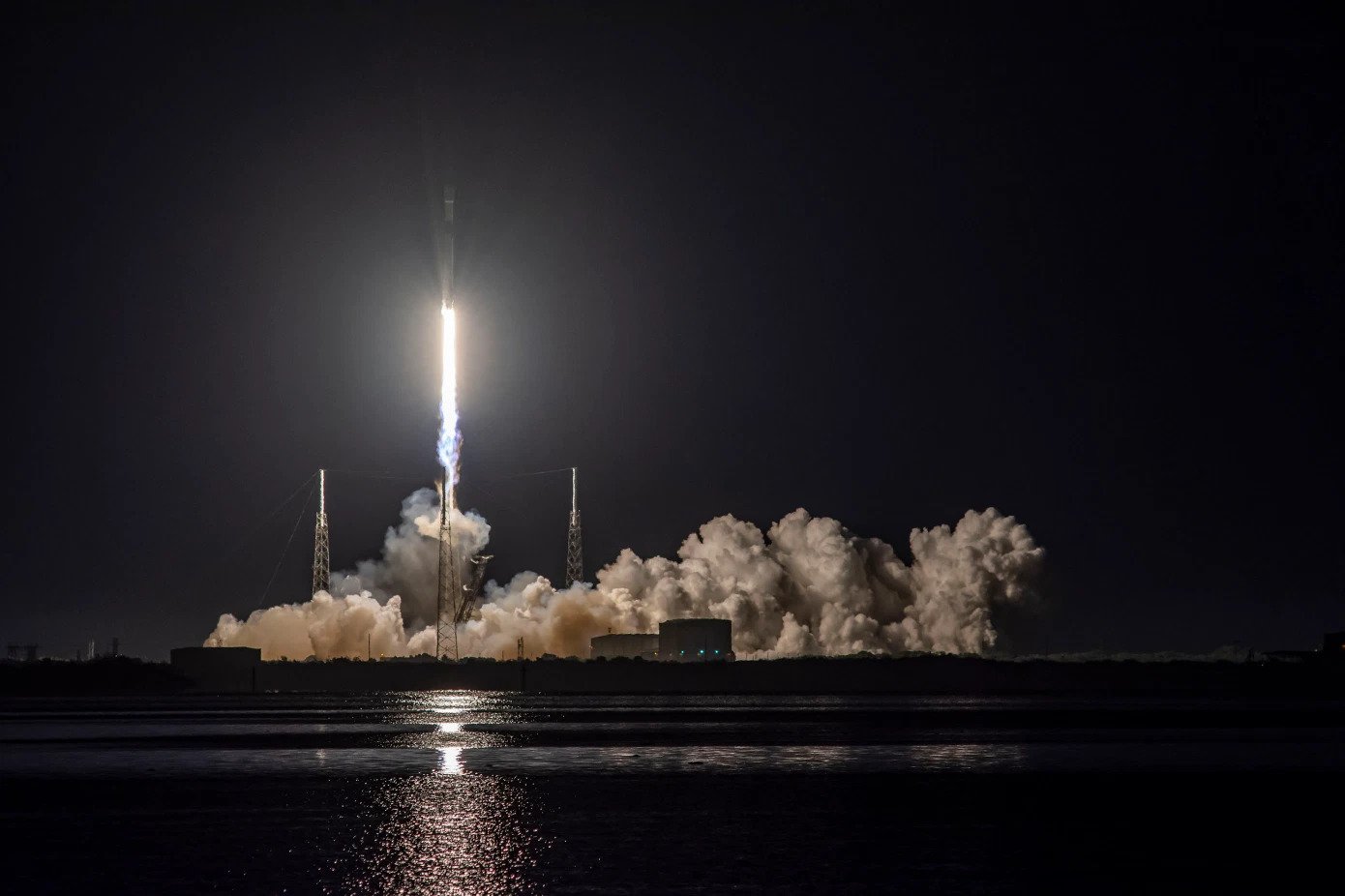
SpaceX has successfully completed its fourth Starlink mission in under a month, adding a further 60 satellites to its constellation.
The latest batch of SpaceX’s broadband satellites brings the total launched this month to an incredible 240.
As usual, SpaceX used its Falcon-9 rocket for the mission. What’s particularly impressive about this launch is the flight-prove booster served on five previous missions.
Over 1,000 Starlink satellites are currently in orbit of 12,000 that have been authorised. Filings have been submitted to the International Telecommunication Union (ITU) requesting permission to launch 30,000 additional Starlink satellites.
SpaceX is currently launching around 60 satellites at a time and aims to have deployed 1,440 by late 2021 to provide near-global service. In addition to today’s launch, the company also held launches this month on the 4th, 11th, and 14th.
Amazon’s Project Kuiper, expected to be Starlink’s biggest rival, was given the green light by the FCC last year to launch 3,236 of its own satellites.
“We are doing an incredible amount of invention to deliver fast, reliable broadband at a price that makes sense for customers,” Rajeev Badyal, Vice President of Technology for Project Kuiper, said at the time.
Earlier this month, Starlink expanded its service to all regions of the UK after a limited trial in southern England.
Starlink’s £439 hardware cost and £89/month service fee reflect that this isn’t a broadband solution designed for everyone—rural communities with limited other connectivity options are the target market.
“This will transform rural WiFi,” says Compare Fibre’s co-founder Nathan Hill-Haimes. “We are really keen to stress the impact this can have on connecting rural locations with high-speed internet.”
Demand appears to be high for Starlink. Dependent on areas, many pre-orders for the antenna and modem kit are extending to the end of 2021.
(Image Credit: SpaceX)
 Interested in hearing industry leaders discuss subjects like this? Attend the co-located 5G Expo, IoT Tech Expo, Blockchain Expo, AI & Big Data Expo, and Cyber Security & Cloud Expo World Series with upcoming events in Silicon Valley, London, and Amsterdam.